Research

Ancestral functions of p53

Our programmes connect transposon suppression, direct transcriptional repression and isoform biology with development and tumor prevention.

01

p53 and transposon suppression

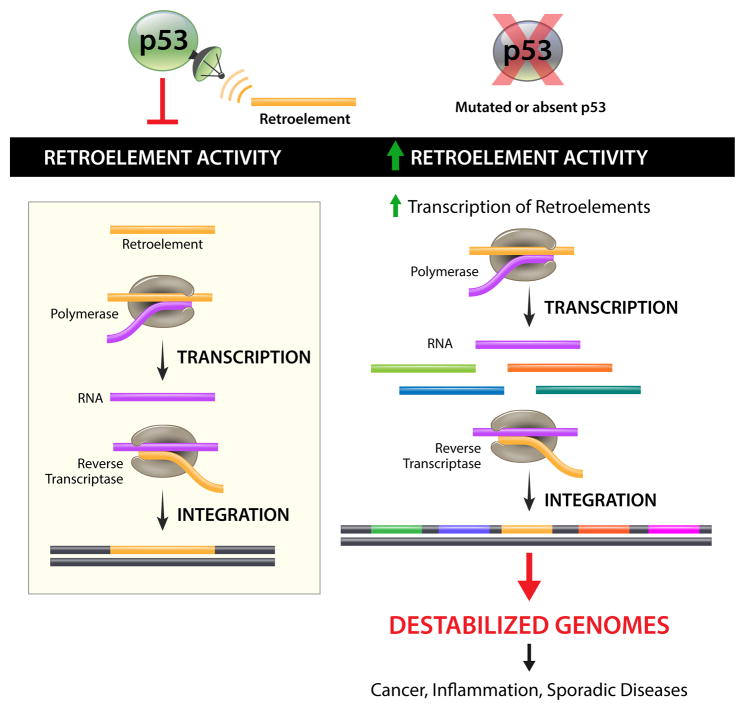
We investigate how p53 restrains retrotransposons—mobile genetic elements that threaten genome stability and are deregulated in disease.

Central question

Is control of mobile elements an ancestral function that contributes to tumor suppression?
Explore this programme
p53 senses and represses retrotransposons. Retroelements move through an RNA intermediate, are reverse transcribed, and integrate into the genome and can cause mutations and genomic instability.
02

Opposing transcriptional outcomes

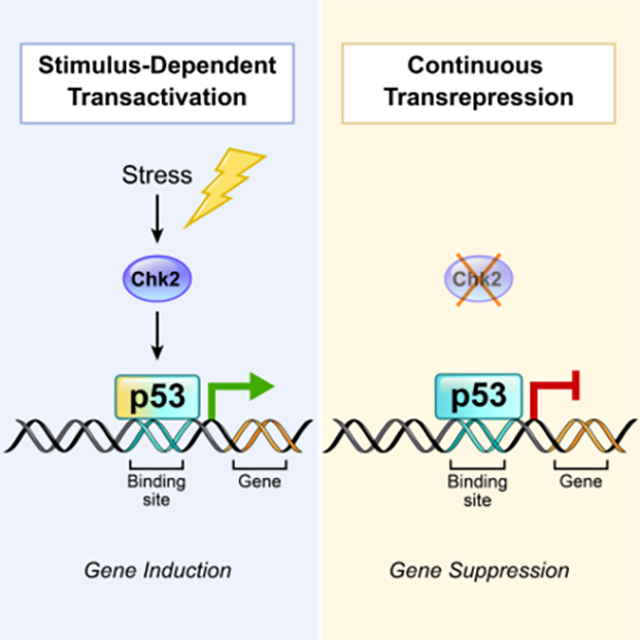
We study how p53 can directly activate or repress genes through the same canonical response elements in different tissues and developmental states.

Central question

How does one DNA-binding factor produce opposite regulatory outcomes?
Explore this programme
Opposing transcriptional outcomes figure
03

Isoform-specific p53 biology

We define how distinct p53 protein isoforms divide transactivation, transrepression and germline functions.

Central question

Which structural features of p53 specify activation, repression and tissue identity?
Explore this programme
04

Developmental origins of tumor suppression

We use ancestral and developmental p53 functions as entry points to discover mechanisms that may be deranged in human cancer.

Central question

What can normal development reveal about the pathways p53 uses to prevent tumors?
Explore this programme